Monday, August 22, 2011

The Forgotten Son: Ron Paul

Ron Paul always seems to not be taken seriously. It's unfortunate. After all, he's the one who said governments should have less influence on people's lives. He campaigned hard on it in 2008. Now, it seems everyone else is capitalizing on his original message. He continues to be forgotten:
The Daily Show With Jon StewartMon - Thurs 11p / 10c
Indecision 2012 - Corn Polled Edition - Ron Paul & the Top Tier
www.thedailyshow.com
Daily Show Full EpisodesPolitical Humor & Satire BlogThe Daily Show on Facebook

The media's ignoring of Ron Paul hasn't gone unnoticed in the mainstream media either:
By now, pretty much everyone agrees Ron Paul was ignored by the media following his second place finish in the Ames straw poll on Saturday. Whether or not the media blackout was justified due to his less-than-favorable campaign prospects is subject to debate.
So what are Paul's prospects? We can judge some of it by his ability to raise money right? Well, he's cash:
Rep. Ron Paul (R-Texas) raised $1.8 million in 24 hours on Saturday and Sunday, a major online "money bomb" timed to coincide with his 76th birthday. This is the fourth time Paul has raised more than $1 million in a day this campaign cycle, and a signal that he will have the money to compete as long as he wants for the Republican presidential nomination.
Paul is still behind Romney and Perry as far as raising money, but the man is raising more money than Michelle Bachmann at this point. He's not going away. And with all that money, he should not go away quietly.

He's also polling well in New Hampshire:
On the ballot Romney remains in a strong position. He leads all candidates with 36% of the vote. However, Perry, making his first appearance in the NH Journal poll, debuts with a strong 18%. Ron Paul continues to impress despite relatively little media attention with 14%. And Bachmann earns 10%. All other candidates were in single digits.
So despite the lack of media attention, Paul continues to raise money and do well in the polls. You've got to still wonder why no one's considering him a serious contender. Is the media attention the only thing keeping him from being a serious contender.

Yet we see all these other candidates that seemingly have no chance getting media attention. Rick Santorum continues to get attention, despite finishing a distant fourth place. Even Jon Huntsman is getting more attention than Ron Paul. What's the deal with that:
Huntsman is challenging orthodoxies of thought that afflict the GOP alone, and taking positions that reflect the conventional wisdom in the media: evolution is a fact, so is climate change, and the debt ceiling had to be raised. In contrast, Johnson and Paul are challenging orthodoxies of thought that are bi-partisan in nature and implicate much of the political and media establishment.
Even more worrying is the fact that not only is Paul getting outshined in media coverage by his fellow candidates, but also by the potential Presidential candidates.

The Tea Party is using a radio blitz for Sarah Palin. Everyone under the sun are waiting for a Paul Ryan or Chris Christie to throw their hat into the race.

It's unbelievable.

In many ways, by not giving Ron Paul fair time or attention, he is becoming a forgotten man in this race. However, the extent to which people are going to ignore him is ridiculous. Palin, Ryan, and Christie aren't even in the race, and attention should not focus on them until they decide they want to serve our country. Huntsman and Santorum are not campaigning nearly as well as Paul, yet they are both getting the mainstream treatment. Whether you like Ron Paul or not, you should agree his voice should at least be heard. The media blackout on Ron Paul is anti-American.

Let the man have a voice.

Sunday, August 21, 2011

The Tea Party Candidate


One of the top challenges for any Republican candidate for President is to win the Tea Party vote.

The Tea Party is a grassroots movement that may or may not be misunderstood. When it first emerged, the protests seemed silly because there seemed to be racially motivated, particularly in the way they tried to convince the public that Barack Obama was born outside the United States:

It's been a very controversial movement:
"Given how much sway the Tea Party has among Republicans in Congress and those seeking the Republican presidential nomination, one might think the Tea Party is redefining mainstream American politics," Campbell and Putnam write. "But in fact the Tea Party is increasingly swimming against the tide of public opinion: among most Americans, even before the furor over the debt limit, its brand was becoming toxic."
In spite of this, it has continued to gain political influence amongst Republican presidential candidates.

Rather than discuss the movement, I would like to address in regards to their Tea Party politics.

Michelle Bachmann has been championing herself as a Tea Party Republican, particularly in highlighting her recent voting record in light of the debt crisis. However, she was burned in Friday's Wall Street Journal for some of her stances:
If Mrs. Bachmann is worried that Mr. Ryan's reforms would not address her concerns, then there are other approaches to choose from. But she has declined to offer or endorse any, expressing only vague support for a small increase in the retirement age and greater means testing—neither of which would make a real dent in Medicare's growth, since neither would reform the grossly inefficient payment system that causes costs to explode throughout the health sector. An asterisk is not enough.
The problem is that while the Tea Party has admirable political goals, its politicians may not have the spine to get things done. Providing concrete policies is an important factor:
A posture of bold fiscal conservatism is simply not compatible with timid evasions on Medicare reform. The combination may be politically convenient, but it is substantively incoherent. And it's not just Mrs. Bachmann who has done this—most of the GOP presidential candidates have as well. Virtually every speech they give is laced with promises to tame our deficit and debt, to scale back the size, scope, reach and cost of government. Yet they have little to say when it comes to fixing the fundamental structure of our health entitlements. They want to will the ends but not the means to those ends. And that just won't do.
You can't shy away from strength. By dodging concrete policies, you're building uncertainty for your campaign. One of the main criticisms of Obama was that he didn't provide concrete policies. I think a 2012 candidate will have to provide a much stronger stance on the issues.

Tea Party activists also have concerns about Rick Perry:
The activists and enthusiasts were much more likely to express doubts about a Perry candidacy. Many were dissatisfied with his time as governor and doubted the authenticity of his conservative credentials.
These are the two "front-runners." I discount Mitt Romney only because I think his religion will be an issue and his spotty record is something that he won't defend. Romney is a smart guy, but he's not charismatic and he's not outspoken. I think he genuinely wants to be President and probably would do a good job if elected. However, he lacks those two traits which are prime on the campaign trail. Oh, and he's definitely not a Tea Party favorite.

Interestingly, the two candidates that would probably most appeal to the Tea Party are not even in the race.

Chris Christie of New Jersey had this to say earlier this year:
And let me tell you what the truth is. What's the truth that no one is talking about-here is the truth that no one is talking about: you're going to have to raise the retirement age for social security. Oh I just said it and I'm still standing here! I did not vaporize into the carpeting and I said it! We have to reform Medicare because it costs too much and it is going to bankrupt us. Once again lightning did not come through the windows and strike me dead. And we have to fix Medicaid because it's not only bankrupting the federal government, it's bankrupting every state government. There you go. If we're not honest about these things, on the state level about pensions and benefits and on the federal level about social security, Medicare, and Medicaid, we are on the path to ruin.
Christie is mulling a run as is Paul Ryan, who brought us the Path to Prosperity:
No one person or party is responsible for the looming crisis. Yet the facts are clear: Since President Obama took office, our problems have gotten worse. Major spending increases have failed to deliver promised jobs. The safety net for the poor is coming apart at the seams. Government health and retirement programs are growing at unsustainable rates. The new health-care law is a fiscal train wreck. And a complex, inefficient tax code is holding back American families and businesses.
Both of these candidates fit the Tea Party agenda so far as cutting government spending and reducing taxes. More importantly, they have a strong record for entitlement reform. They have a strong stance against it and would provide the spine that the Republicans that the other candidates lack.

While the Bachmanns and the Perrys may have the charisma to appeal to the Tea Party supporters, they lack the record to bring about changes the Tea Party activiists can get behind. There's hope that one of these men will run for the presidency. However, until then, the Tea Party activists will have to settle for less.

Friday, August 19, 2011

What is Entitlement Reform?

On my Twitter, I tweeted that if there's anything you're unsure about or you want to learn about, you should let me know. A lot of my own posts start that way. I look at things that are in the news that I want to learn more about, so I research them. I try to apply it to what's going in the world, why it's important etc.

Today, let's talk about entitlement reform.

So what is it? Yahoo! Answers has this:
Entitlements are like government handouts..Welfare, Medicare, and social security are all considered entitlements. The entitlements make up about 56% of the federal budget, so most conservatives believe that they should be reformed.. like raising the age to claim Social security.
So as one would suspect, they have to do with spending initiatives.

With the deficit crisis, entitlement reform has been in the news a lot lately. The cost of a lot of these programs are spiraling out of control and making it hard to control the deficit. Some legislators believe that these costs must be controlled in order to give our country a chance at financial survival.

Let's start at the top with Obama:
"There have been times when our side, when Democrats aren’t always as flexible as we need to be," Obama said. "Sometimes I do get frustrated when I hear folks say, 'You can't make any changes to any government programs.' Well, that can't be right."
This isn't a soft issue. This is something that is going to challenge many people's political ideologies and go against what they stand for. Obama has been a champion of liberal doctrine, but he understands that this is a growing issue:
"We will not be able to sustain that program no matter how much taxes go up," he said in late July. "I mean, it's not an option for us to just sit by and do nothing."
You cannot keep raising taxes to make these things happen. You're taking away the competitiveness of the country if you're taking everything from people and giving it back in the form of entitlements.

These entitlements are a cost driver and are one of the main reasons that the US recently had it's credit downgraded:
"The key thing is, yes, entitlement reform is important because entitlements are the biggest component of spending, and the part of spending where the cost pressures are greatest," Beers said.
So the people responsible for downgrading our debt are cognizant of the fact that entitlements are going to continue to be an issue going forward.

So what's the significance of this?

Well, the debt crisis has created uncertainty and volatility in the markets. There are worries about a potential default in the future. Companies aren't hiring. Much of the problems associated with economic worry are tied to growing debt problems, so tackling and controlling entitlements are going to be one of the top issues of the next election. While the economy will most likely be the top issue, one of the paths to bettering the economy should come through reducing the deficit and reducing uncertainty.

Paul Ryan has been one of the most outspoken politicians on entitlement reform:
Ryan added that he's willing to discuss tax reforms in a way that would promote economic growth and job creation, including addressing "special interest-driven loopholes," but qualified any reforms by adding, "if you're just raising revenues to chase ever high spending, that's not good policy."

Ryan said ultimately the U.S. has to fix its entitlement system.

"The president just created two brand new health care entitlements, expanded Medicaid, a third, and then put this new rationing board in charge of Medicare," Ryan told "Fox News Sunday." "So they're unwilling to open up and restructure these entitlements, which according to S&P are the primary drivers of this debt."
Wall Street agrees:
Bill Miller of Legg Mason Capital Management, who appeared with Ryan, said the markets are looking to see a "reduction in uncertainty," which means both fundamental tax reform and changes to the entitlement structure.

"Discretionary spending doesn't matter at all in this thing except that it'll be a little bit of a drag on the economy. It's pro-growth policies and fundamental entitlement reform, especially on health care, that are the key things for to our long-term fiscal health and therefore the long-term confidence in the markets toward our country," Miller said.
The debt crisis is a top down concern for the markets and for the economy. If we address this debt crisis through entitlement reform, we can help ensure the fiscal safety of our country and work towards suring up our markets' confidence.

So while the election will focus on the economy, entitlement reform should come up. Ryan is one of the most outspoken politicians on entitlement reform and if he decides to run, I will surely profile him. Regardless, his Path to Prosperity will be a topic of discussion.

The question is whether the rest of the candidates take his cue and make it a primary talking point or they try to focus solely on the economy without tackling the debt issue, attacking each others' records and Obama's record. In the meantime, it will be interesting to see if Obama follows through on what he has already said. If he does make the move and extend his hand to implement entitlement reform, will that give him a leg up in the race? These questions will be answered in the weeks or months to come.

Wednesday, August 17, 2011

India's Corruption Problem

India is corrupt. It's been that way for as long as I know. I didn't think that was ever going to change, and I was worried that it would stunt the country's growth. How can you change societal problem that is so widespread?

Wikipedia throws it down for us:
Political and bureaucratic corruption in India are major concerns. A 2005 study conducted by Transparency International in India found that more than 45% of Indians had first-hand experience of paying bribes or influence peddling to get jobs done in public offices successfully.
It's hard to trust a government that allows that much corruption without doing anything about it. It's bad for business. You can't trust anyone, whether they're working for you or whether they're a government official.

My grandfather and uncle run a coconut oil mill in India. They make the best coconut oil in the world. That's a fact. However, they have no desire to expand because any hint of success would lead to unwarranted government harassment. The other problem with expanding is that you can't trust a damn person, even family members. People are greedy and there's no accountability. It's an awful set of circumstances.

Finally, someone has decided to stand up against corruption:
Anna Hazare has quickly become a 21st century Mahatma Gandhi inspiration for millions of Indians fed up with rampant corruption, red tape and inadequate services provided by the state despite the country posting near-double digit economic growth for almost a decade.
Obviously, any Indian protester is going to instantly get compared to Gandhi just as any African-American Civil Rights activist would be compared to MLK or Malcolm X (or Rosa Parks).

Even prominent businessmen are behind this sentiment:
"Democracy means no voice, however small, must go unheard. The anti-corruption sentiment is not a whisper-it's a scream. Grave error to ignore it," Anand Mahindra, one of India's leading businessmen and managing director of conglomerate Mahindra Group, wrote on Twitter.
People are speaking out. It's about time. You can only push people so much until they are going to push back. Now is the time that people feel empowered to share their opinion. An attack on corruption can only help India grow as a nation.

If you're not familiar with Hazare, he was recently jailed and is now fasting:
Hazare, who has struck a nerve with millions of Indians by demanding tougher laws against rampant corruption, had insisted he wants the right to return to a city park where he had originally planned to publicly fast, before he leaves jail.
While some see Hazare as a hero, others see this movement as somewhat hypocritical.

This isn't just a public issue:
Indians have a deep and complicated relationship with corruption. As in any long marriage, it is not clear whether they are happily or unhappily married. The country’s economic system is fused with many strands of corruption and organized systems of tax evasion. The middle class is very much a part of this.
But it goes beyond that. Some of the primary supporters of Hazare were Bollywood stars. However, Bollywood has a shadiness to it as well:
One reason the mafia could get such a firm hold on the film industry in the 1990s was that it had established a business relationship with producers and actors and functioned as an efficient conduit for illicitly transferring their money to safe foreign havens.

Following Mr. Ramdev’s fast, when the government agreed to investigate Indian money hidden in foreign banks, The Times of India ran an intriguing essay that argued that the law should make a distinction between the “black money” of corrupt politicians, earned through kickbacks, and the “black money” of businessmen who had moved their cash abroad years ago to save themselves from unreasonably high tax rates in socialist India. The essay implied that corrupt politicians were the real evil and that the tax-evading businessmen were just smart.
So as you see, there's a dichotomy in views on corruption.

In a society like the United States, it seems like we have a lot less corruption in politics and much more in business. If you're in politics and you're corrupt, you get jail time. If you're a businessman and you avoid taxes, you get vilified.

In India, it's only the politicians that get vilified. This doesn't seem fair and may seem hypocritical. However, why should anyone trust a corrupt government? Why should a hardworking citizen give money to a government it doesn't trust? While I believe there needs to be a full termination of corruption in India, I believe that it will have to begin at the top. After that, you can go after the businessman and even the working man.

Once the government restores the people's faith in it, it can restore its faith in the people.

Flash Mobs: Taking Over


I think social media is a great development, particularly Twitter, but this is an example of it going wrong. I really can't say much more because I'm not these kids. I don't know why they did what they did. It's not something new. No one should ever feel unsafe, but these flash mobs certainly perpetuate a threat to society.

Tuesday, August 16, 2011

Rick Perry and the Aggie Complex

Is Rick Perry just another mediocre Aggie?

Stay with me here.

Rick Perry succeeded George W. Bush as Governor of Texas. Bush ended up serving two terms as President of the United States, while Perry is in the middle of his third term as Governor. Part of me wonders whether the Aggie complex, a constant jealousy of Texas, is the primary driver of Perry's Presidential hopes.

You probably want to stop me there. By some miracle, President Bush went to Yale. Yes, but his brother, Jed, went to Texas and so did his daughter, Jenna. The family has strong ties to the University.

So what's this Aggie complex about? Well, the University of Texas at Austin is the flagship university of the state of Texas. They were the big player in the Big XII and they've always watched out for Texas A&M. They've been more of a little brother to Texas than Michigan State has to Michigan, although the jealousy is very similar.

Recently, Texas announced that they're going to start their own television network.

This has further sparked A&M's envy so much so that they are trying to join the SEC:
In the eyes of most Aggies, moving to the SEC means they'll no longer have to operate in Texas' vast shadow.
Aggies fans overcome with excitement over a move to the SEC. There's also a pretty good explanation for the Aggie Complex in there:
"It’s really hard to watch a bigger school kind of bully their way around the conference and make the money they want to," Turner said. "So you have to do something, but I think a lot of fans are kind of uneasy about, 'Is this what we really want?'"
And more:
"We want to carve our own niche, and we don’t want to be the little brother, but you almost don’t want to leave big brother," Turner said.
They want out of Texas's shadow just as Perry seems to want to get out of Bush's shadow. What's more is the Aggies are trying to move to the SEC to be in a conference of schools in constituencies that Perry will appeal to in his own campaign.

However, the SEC appears to have rejected A&M's bid to join them, at least for the moment:
Southeastern Conference presidents and chancellors committee didn't reject Texas A&M in their meeting Sunday, they simply “reaffirmed (their) satisfaction with the present 12 institutional alignment.”
If Texas A&M joined the SEC, they would be amongst company that has attracted suspicion over the last few years. The SEC has been under scrutiny for a number of reasons, but amongst these is their lowered standards:
The SEC will push for the rest of the nation to adopt its oversigning rules. Thankfully, the SEC will not push its ban on the grad-student exception to the rest of the country. Hopefully, the SEC will remain the only league dumb enough to wipe from the books the only rule in the NCAA that actually provides a positive incentive for athletes.
The fact of the matter is that A&M is trading one problem for another. They have to prove to the rest of the country that they are hellbent on having rules that both preserve academic and NCAA integrity. If Perry is successful in his bid for Republican nomination, he too will be trading one problem for another. He will go from living in Bush's shadow in Texas to being plagued by his shadow on the national stage. Although the conservative southeast helped President Bush get in both 2004 and 2000:

There were cracks in that foundation for McCain because of Bush in 2008:

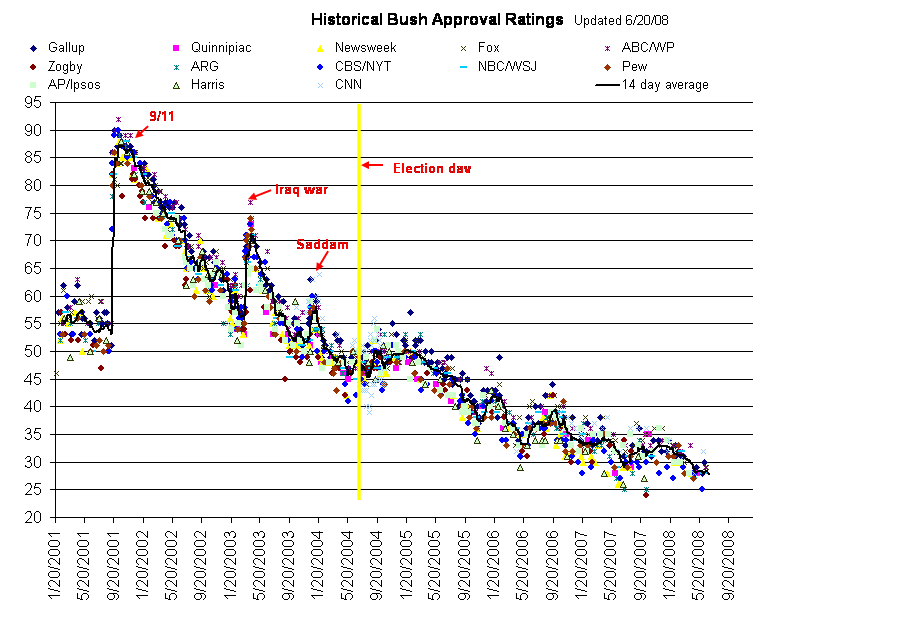
The question is whether Rick Perry can continue his strong start and consolidate the conservative base while appealing to skeptical northerners who might not take to another brash cowboy from Texas. At the end of Bush's term, he did not have a high approval rating:
The similarities will clearly be highlighted in the media and don't think 2.5 years of Obama has made people forget:
The Daily Show With Jon StewartMon - Thurs 11p / 10c
Indecision 2012 - Corn Polled Edition - Rick Perry Announces His Candidacy
www.thedailyshow.com
Daily Show Full EpisodesPolitical Humor & Satire BlogThe Daily Show on Facebook

Perry will have to shake Bush's shadow in order to win the presidency. The problem is that he might not be able to do it. He has similar beliefs and ideologies, and he might not be able to get away from that. If he does, he might lose the bases that he needs to win. In the end though, I see him as being another failed Aggie with an Aggie Complex.


Ali Velshi on The Daily Show

Ali Velshi was on The Daily Show yesterday. He talks about the value of companies and the market as a measure of economic confidence as well as a way to reinvent our economy. Jon Stewart seems absolutely surprised by his honesty and saneness.
The Daily Show With Jon StewartMon - Thurs 11p / 10c
Ali Velshi
www.thedailyshow.com
Daily Show Full EpisodesPolitical Humor & Satire BlogThe Daily Show on Facebook

I'll probably talk more about taxes at some point this week.

Monday, August 15, 2011

GOP Race Heats Up

Despite the departure of Tim Pawlenty, the GOP race is heating up. Over the weekend, Tim Pawlenty dropped out, Rick Perry dropped in, and Michelle Bachmann won the Iowa straw poll. Meanwhile, Obama is touring the midwest.

What's this all mean?

Questions.

Let's start with Rick Perry. First, fact checking his speech:
On a blended basis, we would rate this as a Two Pinocchio speech, similar to many of the other announcement speeches — a mishmash of high-flying rhetoric and facts sometimes tethered uncertainly to the truth. We look forward to rating more of the governor’s statements in the future.
There's some interesting stuff about his claims that low-taxes leading to the success he has had in Texas, including:
Texas, as a state rich in oil and national gas, has also benefited from increases in energy prices that have slowed the economy elsewhere in the country. Higher energy prices have meant more jobs in Texas. Though Perry proudly claims the job growth is the result of a low-tax, anti-regulatory environment, others have pointed to a big investment in education in the 1980s that, yes, was the result of a tax increase.
So let's address this point by point.

How does Texas's economy differ from the American economy:
“Because the Texas economy has been prosperous during his tenure as governor, he has not had to make the draconian choices that one would have to make in the White House,” said Bryan W. Brown, chairman of the Rice University economics department and a critic of Mr. Perry’s economic record. “We have no idea how he would perform when he has to make calls for the entire country.”
It's easy to govern when things are going well. Obama inherited a nation underwater and has had to balance his campaign promises with balance to keep the country afloat. Perry's record in Texas might contrast with the needs of the nation:
“The Texas model can’t be the blueprint for the United States to successfully compete in the 21st century economy, where you need a well-educated work force,” said Dick Lavine, senior fiscal analyst at the Center for Public Policy Priorities, an Austin-based liberal research group.
In Texas, Perry has been questioned by democrats for:
And if Mr. Perry were to win the Republican nomination, he would face critics, among them Democrats, who have long complained that the state’s economic health has come at a steep a price: a long-term hollowing out of the state’s prospects because of deep cuts to education spending, low rates of investment in research and development, and a disparity in the job market that confines many blacks and Hispanics to minimum-wage jobs without health insurance.
This does not sound like a recipe for growth.

On a national stage, this could be a huge issue. Education is probably the second largest point of debate coming into the 2012 election. As someone that is hellbent on improving America's future, this does not bode well for Perry. Considering that education is one of the things that has faced the most cuts over the last few years, and clearly, education has started to fall behind:
I'm a staunch believer in one of the few things that government should invest in is education. However, like all forms of government, you have to make sure it is running efficiently, and that is done through incentives. Massachusetts, probably the most liberal state in the union, understands this:
In Massachusetts, Mitchell Chester, state education commissioner of Massachusetts, said his state, which also posts higher than average scores on the national exam, created a plan to "aim high, make sure results count" by holding schools accountable for results and targeting support to help them succeed.
Seems a little bit off topic, but if we're going to make cuts, I expect education to be one of the victims, and without, a economy high in human capital, we're going to continue to struggle. All of these candidates want to lower taxes, and with the budget concerns, we're going to need to make cuts. It'll be interesting to see how these candidates outline their plans. For Rick Perry, you can't ignore the fact that an investment in education played a role in his success as governor, but that his cuts in education will inevitably be a drag in the future. Perry has benefited from rising oil prices, which is integral to the Texas economy. In a more complex national economy, he might struggle to have the same degree of success.

Furthermore, there are questions about whether Perry can win the middle:
The concern for Republicans, however, lies with those swing voters in the middle. Among independent voters, a slight majority of 50% said government should do more, while 44% said it should do less.
I find this very interesting, considering how many people have been critical of Obama. You have to wonder how polarizing an issue this is. It seems like government is taking adaptive measures, while people might want them to do less or more in regards to spending and taxes.

There are still a lot of questions regarding Perry's candidacy, but there's a belief that he can overtake Bachmann:
Logic says that Perry will eclipse Bachmann in Iowa because he’s as conservative but with the bonus of extensive executive experience. As a fiscal and social conservative who’s an evangelical with a background in agriculture, Perry seems a natural fit for the state.
The question is whether he can make the same connection with the voters that Bachmann seems to have done. Bachmann lacks executive experience and while she has won over a lot of supporters, I think her executive experience is going to be crucial in determining her fate. In many ways, she could be the conservative Obama. In the same way that liberals aren't happy with Obama, conservatives might not be happy with Bachmann.

Bachmann has to prove to conservatives she is not (did they steal my headline?):
Americans are already living with the consequences of electing a President who sounded good but had achieved little as a legislator and had no executive experience. Mrs. Bachmann will have to persuade voters she isn't the conservative version of Mr. Obama.
I don't believe she will. To me, she's a political chameleon, always painting herself in a way that will appeal to her desired constituency:
More substantively, her attempt to position herself at all times as the anti-establishment outsider has made her seem on occasion less principled than opportunistic. She quickly distanced herself from Paul Ryan's Medicare reform when it came under liberal fire, even as she purports to be the scourge of uncontrolled spending. Her recent opposition to the debt-ceiling deal on grounds that GOP leaders should have insisted on first passing a balanced budget amendment, while holding only the House, was a political fantasy.
She seems misguided and her candidacy for President of the United States of America seems like a political fantasy.

For the time being, she's up there with the top dogs, so let's not count her out yet. She's going to play a part in the race, stealing votes from the other two top dogs. I just don't think she can beat two candidates with executive experience. That's a big deal in this race.

My top dog in this race is Mitt Romney. I just worry about his electability. While religion is not an issue with me, it is with evangelical conservatives. Furthermore, I don't think he asserts himself well enough. A big thing he's going to have to do is differentiate himself from other candidates:
“I think understanding how the economy works by having worked in the real economy is finally essential for the White House, and I hope people recognize that,” Romney told reporters after touring and addressing employees at a small manufacturer.

“I respect the other people in this race, but I think the only other person that has that kind of extensive private sector experience, besides me, in the Republican race is Herman Cain. And I respect Herman Cain, but I also think it’s helpful to have had that government experience that I’ve had,” said Romney.
He has to be assertive. He has been riding too high on his qualifications. He has to make an earnest effort to reach out to the voters and take a stronger stance defending his record and his beliefs. People have questions about him regarding the policies that were passed when he was governor of Massachusetts and about his religion. He needs to defend these stronger. You have to convince conservatives that you have strong socially conservative beliefs.

The best candidate does not always win the nomination. Often times, it's about the best campaign. The best candidate, for me, is Mitt Romney. As of now, it appears Bachmann and Perry are running better campaigns. It will be interesting to see how things unravel as things develop.

Saturday, August 13, 2011

The New Front-Runner?

As was widely confirmed, Rick Perry declared his candidacy for President of the United States of America.


With his speech, Perry juxtaposes himself as the business and private enterprise friendly candidate who will restore American pride. As I said before, he is in many ways the anti-Obama.

While I am wary of Perry's social stances in regards to abortion and gay marriage, I was impressed and even moved by his speech. I think he did a great job of appealing to Americans' patriotic values as well as outlining his plans to help America grow in the future.

I believe Perry has a much stronger understanding of what it will take for America to get back on its feet than the current administration. Some of the things that he wants to do is simplify the tax system, repeal ObamaCare, get our credit rating back to AAA, and create jobs - create, innovate, and succeed.

Listen, we're going to need someone who is going to encourage private enterprise. Recovery isn't going to happen through fiscal spending. While infrastructure improvements and updates are necessary, the real long term growth is going to come from a reassurance of our private sector and through the encouragement of innovation. We need a President that understands these needs. Rick Perry understands.

While I will not confirm that he's my favorite candidate, I will say he has catapulted himself to the front of the GOP race for the moment.

The Introduction To The Family Business


The following is my final paper for my Epics, Ancients, and the Mafia class at the University of Michigan. Every once in a while, I like to read the papers that I write for school because I want to see what I think of it after the fact. Usually, when you write these papers, you're so in the zone, that you don't get to appreciate your own work. The Sopranos is one of my favorite television series of all time, and I really enjoyed writing this paper. I hope you enjoy it.

Both as a contemporary representation of the mafia genre and as a contemporary representation of mafia, The Sopranos faced the challenge of connecting with or referring back to previous representations of mafia genre while updating the mafia tradition. To address these challenges, the first two episodes of the series serve a similar role as the proems that begin epic poetry, particularly The Metamorphoses. A proem, in epic poetry, is an invocation that provides the introduction to the story within its context. Usually, it addresses overarching themes, like Achilles’s rage in The Iliad, Odysseus’s suffering in The Odyssey, and transformation in The Metamorphoses. It can, however, also cover underlying problems and consequences or take us to a specific point in time. For example, in The Iliad, Homer takes us to the feud between Achilles and Agamemnon. As a television series that continues the mafia tradition and takes place during a specific period of time, The Sopranos share a relationship of content with the proem of The Iliad. At the same time, it shares a connection with The Metamorphoses in that both stories come at the end of the genre. The major difference is that The Metamorphoses bring us from past to present, whereas The Sopranos makes reference to the past through developments in the present. The proem, the first two episodes, of The Sopranos not only reintroduces the familiar motifs of the mafia genre, but also introduces the relationships, themes, and subplots that will dictate the events of its contemporary story.

In the first scene in Dr. Melfi’s office, Tony gives us insight both into the problems that he is facing and the changes that have occurred since generations past. When he first opens up, Tony tells Dr. Melfi that within the context of the mafia he “came too late” and that he feels that the “best is over.” He goes onto reminisce about his father’s time and how “they had their standards, and they had pride.” The vicarious nature of the second comment reminds us of The Godfather and the first half of Goodfellas when times were better for the mafia and there were no FBI indictments, there was no fear of family members snitching, and there were closer business relationships. These are all the issues that we see introduced in the first couple episodes, which weigh heavily on Tony throughout the course of the show. This struggle between the idealistic past and the less opportune present and future in itself is one of overarching themes of the entire series, but there are many subplots that draw from this struggle.

The subplots within The Sopranos are introduced through Dr. Melfi’s questioning to get to know Tony and to diagnose the source of his panic attacks. As Tony narrates the events that led to his panic attack, we are shown the scenes from that day. We see, however, more than what he tells Dr. Melfi, for he is unable to tell her the details of his business. This invokes the code of silence, referencing past representations of the genre such as Frank Pentangeli’s testimony in The Godfather: Part II or Paul Cicero’s lectures to Henry Hill in Goodfellas. Tony himself admits, at first, that “it’s impossible for him to talk to a psychiatrist.” In the scenes depicting his daily life within the first two episodes, we are introduced to the themes, subplots, and relationships that are generated from the conflict between the past and the present.

The mafia business has been undermined by the downfall of the code, values, and pride that characterized it at its peak. In the first episode, Tony laments to Dr. Melfi that things are “trending downward” and that mobsters today “have no room for the penal experience.” The second episode reinforces this demise when Tony’s crew watches a discussion of the RICO trials’ effect on the mafia, especially in terms of leadership and values. We immediately see examples of these waning values. In the same episode, Junior calls for a sit down with the acting boss, Jackie Aprile, rather than making an arrangement to talk to Tony face to face. After Jackie dies, Junior and Tony continuously spar over control of the family and the spoils of the family tributes. This dispute exemplifies both the downfall of leadership and values, since a solution could have easily been reached had they worked together rather than against each other. Furthermore, there are some in the business who break the code of silence like Big Pussy Bonpensiero when confronted with a lengthy jail sentence (2.1). Pussy is arrested for selling drugs, which mirrors the experiences of Henry Hill in Goodfellas and resonates Vito’s proclamation to Sollozzo in The Godfather Part I that “drugs are a dirty business.” While the business still provides a living for these men and their families, the admirable traits that characterized the “family business” in The Godfather has eroded.

The maternal authorities have a more significant role in the influence of family matters. Through Tony’s interactions with his mother, Livia, we see the overall toll and effort that Tony must put forth in his interactions with her. When Dr. Melfi presses Tony about Livia’s ability to burden him with so much guilt, Tony cites how his mother “wore [his father down] to a little nub” to indicate her power over him. We also see that same maternal control within Tony’s own household. Carmela does not want Tony’s mother living with them despite his wishes (1.2), and Carmela is the sole decider of Meadow’s punishment for breaking curfew (1.1). This theme recalls the The Godfather Part II, when Michael is powerless to Kay in regards to the abortion and their marriage. Additionally, when confronted with the prospect of losing his family, Michael goes to his mother as the authority figure on family. While the scale of maternal influence is magnified in The Sopranos, it is important to note that Vito tells Johnny Fontaine in the very first scene of The Godfather, “a man who doesn’t spend time with his family can never be a real man.” The influence of women continues in later episodes when Carmela tears up Meadow’s Berkeley letter (2.8) and when she accosts their neighbor, Jeannie Cusamano, to persuade her sister to write Meadow a letter of recommendation to Georgetown. The increased presence of feminine aggression within the household has broken the balance that is idolized in The Godfather.

The differences in generations and their values have created conflicts both in the business and family worlds of the mafia. All of these conflicts derive from the interpretation of what is respect. Junior and Livia believe that the younger generations must treat their elders with respect and dignity. To Tony, his crew, and even Carmela, respect is received on a merit basis. For the younger generation, respect is more about fame and recognition. A good example of this conflict is Tony’s attempt to put his mother in a “retirement community.” Livia refuses to move because, to her, it is a nursing home and not a dignified residence. We also see Christopher struggle with his lack of fame and reputation, when his diseased friend, Brendon, is named as a Soprano-family associate and he is not (1.8). He rashly shoots a baker in the foot after the baker disrespected him by skipping him in line, and later, he becomes depressed until he is told by his mother that he has been mentioned in the Star Ledger in a mafia related article. This provides a Little Caesar moment for Christopher, as he joyously rushes to a newspaper rack to claim all the papers. While Christopher is satisfied with his new recognition, Tony and his crew are unhappy with the immaturity of Christopher in his actions and his jeopardization of the family’s business. The cohesiveness and understanding that we saw in The Godfather has been replaced with unrest between the generations.

Italian identity and culture is constantly rearing its head as a point of contention within The Sopranos. First and foremost, it is important to recognize that the mafia genre is a product of Italian cultural values. The Sopranos features many representations of Italian culture and values through food, assimilation process, and the family. One of the reoccurring viewpoints in The Sopranos is the rape of Italian culture. In the coffee shop with Pussy, Paulie resents the fact that “all these other cocksuckers are getting rich off ” of the coffee business (1.2). Another example of this rape, ironically, is when the mafia has to fight with Native-American protesters at the Columbus Day parade, a holiday that is very important to Italians (4.3). Another example that is riddled with irony is when Tony, Paulie, and Christopher go to Naples on business, Paulie has trouble adjusting to the differences of real Italian food (2.9). On the same trip, Tony is enchanted by the female boss of the local mafia, Annalise, much in the same way Michael was struck by a thunderbolt when he first saw Apollonia in The Godfather. We also see the religious values of Roman Catholicism in Tony’s marriage with Carmela, juxtaposing Carmela as the faithful and Tony the unfaithful. Unlike Michael and Kay in The Godfather Part II, however, Carmela and Tony are binded together by their adherence to catholic stance against divorce, even if their relationship is not mutual. The presence of cultural values is integral to our understanding of the time and place where these characters come from and the world in which they live.

The proem of The Sopranos provides us with the lens and the scope through which we will see the rest of the series. Through this, The Sopranos develops aspects of the mafia world that have never been addressed before. Never have we seen the extent by which the depiction of mafia in such an expansive fashion. In the proem we learn that the story is not just about Tony and how changes in his business are stressing him out, but rather about the world he lives in within the context of a mafia tradition. As a story about America experience and assimilation, we are able to see contemporary depictions of events that are able to exist without sacrificing the necessary focus of the narrative to center on the mafia itself.

Friday, August 12, 2011

Enter The Fray - Rick Perry


So Rick Perry is expected to announce his candidacy for President of the United States of America tomorrow. His foray into the race should see him instantly catapult him to the top of the Republican race. He will probably run on a jobs candidacy, being the only candidate with a strong record of job creation from public office. This should give him a strong leg up over Mitt Romney and John Huntsman, both of whom were successful businessman.

So how does he stack up?

Well, the man can fundraise:
“He is the most successful fund-raiser in the history of Texas politics,” said Craig McDonald, director of Texans for Public Justice, a watchdog organization that tracks campaign spending. “He may be the best in the country. He will have no trouble raising the money he needs for his presidential campaign.”
Only Mitt Romney can compete with Perry in terms of money raised. In the last two weeks, he's raised twice as much as every other candidate. Financially, Rick Perry should be one of the toughest candidates to top.

As I said before, he will be the job's candidate:
Over the past year, Texas' job growth was twice the national average. In fact, of all the jobs created since June 2009, 30 percent – about 295,000 jobs – were created in Texas, according to a report from the Dallas Federal Reserve which analyzed data from the Bureau of Labor Statistics.
That should make him a favorite in this recession. People want someone who will be business friendly and help the economy grow. Not someone who will continuously mislead the economy and not give a certain outlook over their future actions.

So what's been the secret to his success? Taxes:
Yucel said much of this job growth can be attributed to Texas' low tax rate – the state has no income tax -- few regulations and a law limiting tort litigation. Texas, according to Perry, is the "epicenter of growth."
Low taxes and few regulations are business friendly. Limited tort litigation is doctor friendly. In many ways, Perry is the anti-Obama. From the two and a half years we've seen so far, an anti-Obama is just what we might need to grow as a country.

Or is he? According to Joseph Henchman, while Perry decreased franchise taxes, he increased margin taxes, resulting in increased revenue:
"I think Perry's margin tax in Texas is a destructive type of tax," said Joseph Henchman, the vice president of state projects for the Tax Foundation. "You have taxes being levied on taxes based on how many levels of production a product has. It basically encourages people to form conglomerates purely for tax reasons which is economically destructive. You have these taxes pyramiding on each other so the effective rate is higher."
But what did Perry's opponents do? Unemployment under Pawlenty as Minnesota governor:
Still, 25 states had a lower unemployment rate in June 2011 than Texas, including Pawlenty's state of Minnesota in which 6.7 percent of the population is unemployed.
And the budget:
Pawlenty took office in 2003 when the state's budget was facing a $2 billion shortfall. Within his first year as governor Moody's rating agency downgraded Minnesota from a perfect AAA credit rating to AA1, one step lower, citing short-term fixes to long-term budget woes as the reason for the downgrade.
Despite the unemployment rate, Pawlenty has let his state's debt get down graded. He didn't solve the state's problems, but rather slowed it down by slowing down spending. It sounds very similar to what Boehner's plan appears to be doing.

Romney helped raise Massachusetts's credit rating:
Conversely, during Massachusetts Gov. Mitt Romney's tenure from 2003 to 2007, he petitioned the S&P credit rating agency to increase his state's credit rating from AA- to AA, which they did in 2005, according to a report obtained by Politico.
But did he raise taxes:
But the credit upgrade did not come without a cost. In 2002 Massachusetts raised more than $1 billion in additional tax revenue and in 2004 the state increased fees such as those for drivers' licenses, raising an additional $271 million annually, according to the report.
Actually, no:
Henchman said former Romney is the only GOP candidate who saw income taxes decrease while he was in office, albeit slightly, from 5.6 percent when he took office in 2003 to 5.3 percent by the time he left in 2007.
The article seems a bit misleading about this fact.

Meanwhile, Huntsman went with a flat tax:
"Huntsman's flat tax achievement is an achievement," Henchman said. "It reduced complexity and it made it a much more growth-friendly tax system."
You may ask why I'm focusing on taxes, the credit rating, and job creation. Because it's going to be the most important talking point for debate for the 2012 election. It should have been for the 2008 election, but instead they focused on healthcare, immigration, and the war. As I said then, the economy is always the most important issue whether it's good or bad.

The 2012 election will be about creating jobs, solving the debt crisis, and restoring the credit rating of this country.

However, since people do like to focus on other, relatively minute details, let's look at Perry's social stances. He is staunchly anti-abortion and anti-gay rights:
Governor Perry and the supporters of "the Response" can say all they want that the prayer rally was a non-political event, but the fact is the event was sponsored by the American Family Association, an exclusively Christian group with a narrowly-focused political agenda that revolves mostly around outlawing abortion and curtailing gay rights.
I have a hard time taking these types of people seriously. You know, the ones that not only are intolerant in their private lives, but also feel it is their mission to force their views on your publicly. For me, it's hard to trust someone for this. One of the founding principles of our country is the separation of church and state and when someone's viewpoint is derived from religious beliefs, you are blurring that very sacred line.

Carl Medearis feels similarly about the political implications of Perry's religious rally:
But here's my suggestion for the next politician that feels the need to call the nation to prayer, and wants to do so in a way that honors Jesus. Why not make the event open to people of all faiths and political persuasions? And rather than focusing on a narrow set of political concerns, why not make the focus of prayer something that Jesus actually talked about, like removing the planks from our eyes before we judge others... and loving our neighbor as ourselves?
Regardless, the "Response" may have been a political move to consolidate support of the conservative Christian base:
By leaving politics out of The Response, Perry formed a bond with the evangelical community that no other 2012 Republican presidential candidate has, at least on such a large scale: He earned their respect.

"I think by him not saying anything [political], that shows he kept his word," Stringer said. "I think if he had said something, he would have totally lost any equity with anybody. By not doing anything, even those that don’t ever vote for him, those that don’t agree with his politics, they can say ‘you know what, we can pray for that guy, and he went up a notch in my book.'"
y
Yes, but the event was still sponsored by a anti-abortion and anti-gay rights group. So what about that homeboy? It's all politics, right?

Whether or not I'm a fan of Rick Perry, he might be the candidate to beat. Regardless of how annoyed I get with social issues entwined with religion and politics, this election might be about jobs. I think we have a lot to learn about all of these candidates in regards to what they intend to do to help grow our economy. However, on record, Rick Perry appears to be one of the stronger candidates. I can't really knock him for that, and it appears the Obama administration is already taking notice.

The 2012 election is about jobs. When you're voting in the caucuses and primaries as well as the general election, keep this in mind. The economy should outweigh everything else.

Jamie Dimon Believes in America

Thursday, August 11, 2011

USPS - Does it have a future?

I walk my dog in the late afternoon. The past couple times I've walked him, there has been a USPS truck with the driver just chilling in the front seat. Now, I was going to take a picture of this today, but I decided not to because I don't want my mailman to lose this job if this actually becomes more publicized, but I wanted to use it as an opportunity to get into the USPS debate.

As for my postman, is he off the clock? Did he already finish his routes and is he just waiting for quitting time? What's the deal here?

If you are unaware, USPS posted a $3.1 billion loss in its third quarter:
Total mail volume for the quarter that ended June 30 fell to 39.8 billion pieces, a 2.6 percent drop from the same period a year earlier, as consumers turn to email and pay bills online.
And what might exacerbate the system is a series of prepayments that will create cash concerns for the struggling postal service:
"We are experiencing a severe cash crisis and are unable to continue to maintain the aggressive prepayment schedule," Joseph Corbett, the agency's chief financial officer, said in a statement.

"Without changes in the law, the Postal Service will be unable to make the $5.5 billion mandated prepayment due in September."
With the government's debt as it is, it is unlikely that the government will be able to assist the USPS as it could in a more stable financial situation.

Additionally, like many government run bureaucracies, the post office isn't run efficiently and isn't allowed to be run in that way without the permission of congress:
Postal officials have called for Congress to change the way USPS operates, saying it needs more flexibility to close failing post offices, cut Saturday delivery and raise rates.

The agency is studying about 3,700 of its 32,000 post offices, stations and branches for possible closure. Officials plan to replace post offices by contracting with private retailers to sell stamps, offer shipping and provide other postal services.
The losses have caused postal higher ups to take shady measures in order to limit costs and to maintain its public image:
Managers at the U.S. Postal Service have skirted the agency's performance evaluation rules, reducing or eliminating employee salary increases in some cases to avoid the negative publicity that bonuses could bring the financially ailing agency, according to a new audit.
Here's how it was done:
Forty-six percent of evaluators and 40 percent of second-level reviewers surveyed reported that employee ratings were lowered during the review process. Respondents said they were instructed by a superior to bring ratings into line with average scores or believed that ratings should be lowered to avoid raising suspicion. Others were concerned that employee performance targets were too easy to meet or that the public would react negatively to workers receiving bonuses given the agency's fiscal condition, the IG found.
I don't want to get into an argument about whether these measures were right or wrong. I understand why they did them, but it doesn't make it right. The problem is the system.

As far as solutions, there are many. These range from finding cost savings or getting rid of the postal monopoly all together. Here's a bit of a cost reduction argument, regarding those pre-payments:
The problem lies elsewhere: the 2006 congressional mandate that the USPS pre-fund future retiree health benefits for the next 75 years, and do so within a decade, an obligation no other public agency or private firm faces. The roughly $5.5 billion annual payments since 2007 — $21 billion total — are the difference between a positive and negative ledger.
Mail is not the problem. It's these pre-payments that are the problem:
Furthermore, USPS' financial problems have surprisingly little to do with delivering the mail. In the past four fiscal years, despite the worst recession in 80 years and despite Internet diversion, revenues from postal operations exceeded costs by $611 million.
Mack Julion of the National Association of Letter Carriers has this to say in defense of the postal services:
The fact remains that everyone does not pay their bills online or even have access to the internet. Those who live in rural communities, low-income areas, and the elderly would be impacted the most by the slower delivery time that would result from just one less day of mail service. The Postal Service is still very relevant and for only 44 cent a stamp we don't require a dime of your tax dollar! If it was not for the congressional mandate to pre-fund our retirement, the Postal Service would have seen profits of over a half a billion dollars over the past five years. Right now the United States Postal Service does not need to close post offices, reduce services or a bailout -- we just need Congress to fix the law that is breaking your Postal Service.
The cause of the trouble is something everyone agrees on. It's the pre-payments.

How to solve this issue is the disagreement. Some think this should be done directly. While the proposed solution is to close down branches.

Personally, I believe the solution is more institutional than anything. The constraints put on the USPS put them in this situation. They need more leeway in how they can manage these things. They cannot make decisions regarding it's financial viability without the approval of congress. This puts them on an uneasy plain. It is not efficient to have this bureaucratic liability. The post office needs more freedom.

As far as getting rid of the post office, I think it's a bad idea. While most services have become digital, the post office still serves a purpose. It would be unwise to disband it.

Monday, August 8, 2011

Welcome To London


Out of control?

Vigilance At A Premium

It seems like vigilance is at a premium. If you're a long term investor, you're probably raising an eye brow and wondering what you should do with your money. People have been selling frantically the last couple weeks and the market has taken a sharp drop. The money has come out of equities and been shoved into fiat currencies like gold and to a lesser extent silver. At the same time, oil and copper prices have fallen, while the US dollar has gained on the Euro as greater concerns arise in Europe.

So what do we make out of all of this? Do we follow the experts and take our money out as well?

I don't think you can panic sell. Cutting your losses seems like a mistake when you can hold and accumulate higher dividend yields and reinvest them into more stock, which will increase in value as the stock recovers. If you sell, you're letting your losses stand.

You're probably also worried about this credit downgrade. I don't think it's necessarily a bad thing. Here's the bottom line:
Neither side can easily claim the high ground. The downgrade laid bare a distrust of both the Washington political system and the independent firms tasked with standing in judgment of it. Ultimately, investors are likely to be responsible for deciding who has more credibility.
The downgrade was down to one thing: democracy. Because of the quibbling between the two parties and the time it took for the deal to get done, S&P felt compelled to downgrade.

The Obama administration say it's down to an accounting error, and while that may be the case, I still don't think this is a bad thing. At the very least, it will make them work that much harder to address the debt situation, so we can get back the AAA rating. In the meantime, do you really believe that the US will default on their credit now? You think not having that rating means we're less likely to pay off our debts? We came close, but we got the deal done. Are we going to not do that next time? In the end, these people know the importance of paying off our debt. They're not complete idiots, though they may seem like ones at times. I'm not saying that the rating downgrade is meaningless, but it doesn't mean as much as it is made out to be.

You can remain calm about it.

Burton Malkiel had this to say in this morning's journal:
Investors who have sold out their stocks at times when there have been very large declines in the market have invariably been wrong. We have abundant evidence that the average investor tends to put money into the market at or near the top and tends to sell out during periods of extreme decline and volatility. Over long periods of time, the U.S. equity market has provided generous average annual returns. But the average investor has earned substantially less than the market return, in part from bad timing decisions.

My advice for investors is to stay the course. No one has ever become rich by being a long-term bear on the fortunes of the United States, and I doubt that anyone will do so in the future. This is still the most flexible and innovative economy in the world. Indeed, it is in times like this that investors should consider rebalancing their portfolios. If increases in bond prices and declines in equities have produced an asset allocation that is heavier in fixed income than is appropriate, given your time horizon and tolerance for risk, then sell some bonds and buy stocks. Years from now you will be glad you did.
The US market has grown over time. To not be in the market is to miss out. To cut your losses is to miss out.

I think we're getting into the time where it's time to buy. Listen, over the past couple weeks, some of the best stocks have declined with the markets, coming off highs as a result of solid earnings reports. I see this as more of an opportunity to get these stocks on the cheap than an opportunity to sit on your hands. Fundamentally, these companies are still doing well and there's a reason that they were as high as they were. Now the shares are more affordable. You've seen the upside they have when things are normal. The last couple weeks, everything has fallen save for gold mining companies. Find a company you like and think has a lot of upside and dig in.

I'm a soon to be buyer, not a too late seller in this current market. I'm vigilant. I don't think this is going to get much worse. To think that this decline is the end of the world is short term thinking. You can't let volatility and declines get to you in the short term. You need to let it ride in the long-term. I am still a bull on America, as hard as that might be to be right now.